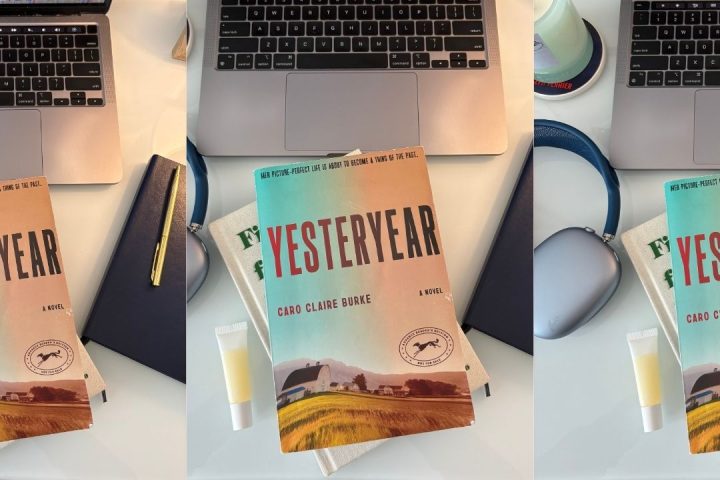
‘Last Year’ Answers the Question: Can Tradwives Survive What They Do Online?
var skimlinks_settings = {
noskim: right
};
If you find yourself on the internet in any capacity, from discovering short-form Facebook content to the double-digit driving watch time of TikTok scrolling, you’ve probably come across the interesting corner of the internet that is traders’ wives. These accounts, with their very simple kitchens, adorable children with strange and old-fashioned names, and their millions of followers, show an ideal version of life: a life where mothers always appear put together, spending their days taking care of the house and cooking elaborate meals for their nuclear families.
Clearly, these stories, which appear to be drawn from the 1800s, have been the subject of discussion for years. Their explicit traditional gender roles and clear longing for a time when anyone who didn’t look exactly like the head of the family (i.e., white, heterosexual, and male) had no rights makes one wonder. There’s an almost eerie quality to it. You can’t look away, even though what you see is unsettling, even though the lighting in their house is perfect. So when a “tradwife thriller” featuring such horror took the publishing world by storm, it caught the attention of readers everywhere. Next up, my full review of the novel everyone is talking about right now—The past.

The past
A traditional American woman, a “tradwife” influencer, suddenly awakens in the brutal reality of 1855—where she must uncover whether this living nightmare is an elaborate hoax, a twisted reality show, or something far more sinister in this sensational debut novel.
Shop at Bookshop.org, Amazon, or Libro.fm
What The past about?
The past follows Natalie, a traditional American woman with millions of followers. He lives in a beautiful farmhouse, with its industrial-grade oven and refrigerator hidden away. She posts about herself and her effortless life, even though her viewers don’t know about the nannies and producers who keep everything running smoothly. The women who made hateful comments on his page were sick with jealousy. I mean, it was Natalie who made her dream come true.
That is, until one morning she wakes up to find herself in an 1800s version of her house, somehow transported to the pre-electric era, with versions of her children and husband she doesn’t recognize. This is not the life he knows, and every moment he spends in this reality, he realizes that this is the life he must escape, whatever the cost.
My review of The past
Yes, The past is a thriller with a truly fantastic storyline, but the most interesting thing about this story is definitely the main character. Throughout the novel, we are in Natalie’s head—and let me tell you, it’s not a pretty place. To say Natalie qualifies as an unlikeable main character is an understatement. While his mind is clearly a space full of hatred and slander, it is also a very interesting setting for the story. Natalie’s point of view as an antihero criticizes the tradwife trend very well, in layers and in a complicated way.
The main narrative about online trafficker wives is that they have been robbed of agency – that their traditionalist husbands have forced them into this life. Ballerina Farm’s TikTok comments are full of people urging others to “free her.” I often heard that when she was at the peak of her ballet career, he clipped her wings, forcing her into the kitchen and motherhood. Although obviously we don’t know what actually happens in these real world scenarios The pastIt was Natalie who was in complete control.
Rather than being trapped in a world where men are the only people who might have the ability to make decisions—and have to be the brains behind multi-million dollar media companies, while women are all in on it—The past allowing Natalie to have control over her life. She makes it herself from scratch (like the recipes she posts online). Yes, his inner monologue reveals his disgusting view of others, his selfishness, and his inability to feel empathy, but within that hatred, there is also ambition and a willingness to do whatever it takes to get what he wants.
It gives Natalie a very cool, blunt point of view that is much harder to accept, along with the real tradwife influencers I see on my timeline. I almost want these women to be victims of their husbands’ puppet masterminds because it’s much easier to understand men who benefit from the patriarchy than women who reinforce the patriarchy for their own financial and social gain, even if it is to the detriment of other women. The idea of a man hating women is nothing new, but reading how hard Natalie hates other women, how she rolls her eyes at them and their goals, and how aware she is that they’re judging her outright isn’t easy to read. No matter how harsh her thoughts and opinions are, you still have empathy for Natalie. After all, she was born into a world run by men just like the rest of us, and she took advantage of it to provide for her family.
As Natalie enters the 1800s, she is forced to truly experience the message her account conveys. Even though he firmly believes in the anti-women rhetoric he peddles online, he is forced to experience the true brutality of those messages. What does it mean to answer a man’s questions, without millions of dollars in your pocket to soften the blow. When his illusions are cracked, he tries to find his way back to the world where he shows a submissive life online, urging women to follow his way, but he actually has powers. Although as we see this happen, you have to ask yourself if he really has powers.
Another very interesting theme in this novel is the idea of performance. The juxtaposition between Natalie’s inner monologue and her actions reveals how, at every step, she performs. Whether the audience is his actual social media followers, society’s expectations, or his personal performance for God, this prompts us to examine where we are performing in our own lives. Natalie is obsessed with appearing flawless in front of everyone around her, and although she tries hard, it’s something we all try every day.
“The past is one of the most interesting deep dives into modern internet culture I have ever read.”
When someone seems perfect—even though we know it’s a lie—we can’t help but misstep them, revealing the true turmoil inside them. As viewers, some of us enjoy watching Natalie (and the other traders’ wives in our FYP) fail, spiral, and unravel because it means that even someone with money, success, and privilege can’t be perfect. And when they have flaws, we finally allow ourselves to have them too. In this book, we witness that destruction and destruction, knowing Natalie’s role in it, wanting her to succeed and fail at the same time. Diving into that contradiction is why The past has attracted the attention of many people.
The trader phenomenon provides an effective backdrop for this character study. There is something romantic about the traditional cowboy life. I mean, cowboy love stories are all the rage right now. yellow stone has a million spin-offs. Every It girl in New York City wears cowboy boots on the street. The image of being able to buy a large, beautiful plot of land and create our own country retreat (complete with all the luxuries of modern life we’re used to, of course) with an Americana aesthetic is an easy sell. And no matter what the comments sections on these accounts look like, we’re fascinated by the stories these people tell.
Even if you love your independence and the desire to have children is non-existent, when you’re immersed in the nine-to-five, we can all romanticize a life where your biggest worry is whether your sourdough starter will improve. Some of us want to believe the lies the merchants are selling, and The past taking that desire and exploring it in depth, deconstructing the fantasy. It’s addictive, as is scrolling through these influencers’ pages.
While on Instagram, you can create your own stories about slightly scary families you see online—The past fills in the “what if” void for you, expertly highlighting the possibly sinister nature of these stories and how the world around us is to blame with its extreme views, breaking news and the kind of chaos that makes an escape into the past look absolutely brilliant.
So, you better read The past?
If the “trade wives thriller” hasn’t convinced you to read this book, let me be the encouragement you need. The past is one of the most in-depth dives into modern internet culture I’ve ever read. Caro Claire Burke manages to create one of the most unlikeable main characters I have ever encountered while still leaving the reader with empathy. The report expertly critiques gender roles, the way we consume content, and the way we appear to audiences—whether audience scrutiny comes in the form of God, Instagram followers, or societal expectations. This is one of those books you read and immediately want to start over to catch everything you missed the first time.
window.fd(‘form’, { formId: ‘69498d871c4452f462816f41’, containerEl: ‘#fd-form-69498d871c4452f462816f41’ });

Lauren Blue, Associate Editor & Book Club Host
As Associate Editor for The Everygirl, Lauren ideas and writes content for every aspect of our readers’ lives, from must-read books and behind-the-scenes interviews to the beauty products she can’t live without. When she’s not sitting at AMC watching the hot new releases, she can be found browsing Goodreads for the perfect picks for The Everygirl Book Club. There, he co-hosts discussions with members, debating storylines, fancasting characters, and, of course, giving his own recommendations.
var skimlinks_settings = { noskim: true };
The Post ‘Last Year’ Answers the Question: Can Tradwives Survive What They Do Online? first appeared on The Everygirl.
PakarPBN
A Private Blog Network (PBN) is a collection of websites that are controlled by a single individual or organization and used primarily to build backlinks to a “money site” in order to influence its ranking in search engines such as Google. The core idea behind a PBN is based on the importance of backlinks in Google’s ranking algorithm. Since Google views backlinks as signals of authority and trust, some website owners attempt to artificially create these signals through a controlled network of sites.
In a typical PBN setup, the owner acquires expired or aged domains that already have existing authority, backlinks, and history. These domains are rebuilt with new content and hosted separately, often using different IP addresses, hosting providers, themes, and ownership details to make them appear unrelated. Within the content published on these sites, links are strategically placed that point to the main website the owner wants to rank higher. By doing this, the owner attempts to pass link equity (also known as “link juice”) from the PBN sites to the target website.
The purpose of a PBN is to give the impression that the target website is naturally earning links from multiple independent sources. If done effectively, this can temporarily improve keyword rankings, increase organic visibility, and drive more traffic from search results.