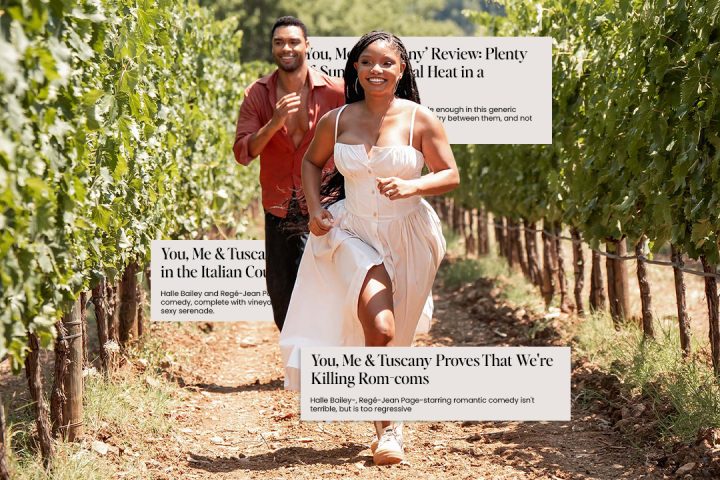
If ‘You, Me & Tuscany’ Fails, We Probably Won’t See a Film Like This for Years
When You, Me & Tuscany—starring the stunning Halle Bailey and the absolutely stunning duke, Regé-Jean Page—was first announced, I realized that it had been a long time since I’d seen a romantic comedy in theaters, let alone one led by two black actors. Needless to say, I felt dizzy. I didn’t realize how much I missed seeing Black Love on the big screen. But the more I thought about it, the more my joy was replaced by something else—unexpected pain.
Black stories, especially those centered on black love, deserve as much space as stories featuring white characters. However, whenever we finally get a moment on the big screen, it’s filled with pressure. Rather than simply enjoying the film, we should become hype people, spokespeople, and cheerleaders because we know what is at stake. The future of black films often depended on the success of the films that were ultimately approved by Hollywood. And, we also knew that our film would be scrutinized more strictly just because the characters were black. For filmmakers struggling to bring these stories to life, the pressure is even greater. The stakes aren’t just personal—they’re also structural. Every project carries the weight of opening (or closing) the door to what comes next. What was supposed to be a relaxing night at the movies became a form of activism, resistance, and the burden of proving that our films are worth seeing too.
Why ‘You, Me & Tuscany’ should be a box office success
Black films are still treated as a risk
Black films, regardless of genre, carry the additional burden of having to “prove” that they can sell to mainstream (read: white) audiences. And even despite the data consistently demonstrating that diverse films often outperform those with less diverse casts, Hollywood continues to move forward—treating each new project as if that success has not yet been achieved.
At first glance, the industry may appear to be progressing. In recent years, more and more films led by Black and BIPOC creatives are reaching mainstream audiences, with directors like Ryan Coogler, Jordan Peele, Jon M. Chu, and Chloé Zhao achieving critical and commercial success. But behind the scenes, those expectations haven’t changed as much as they might seem. Filmmakers still report having to justify their audiences, budgets, and reach time and time again.
The figures make the contradiction clear. Films with 40 to 60 percent diverse casts consistently generate higher profits than films with much less diversity. However, the studio continued to make cuts, insisting that audiences still needed to be “vindicated.” Therefore, each theatrical release is treated as a kind of litmus test, not only for its own success, but also for the future of Black storytelling as a whole.. Our films are not given the space to simply show if we want more of our stories to be told.
Black rom-coms have bigger stakes
I love a good rom-com. There’s nothing more fun than wrapping yourself in a blanket, grabbing an ice cream cone, and grinning from ear to ear as a predictable love story unfolds. As cheesy as they are, rom-coms always remind me of the magic of love and give me hope that fairy tale endings are possible for everyone.
The 90s and early 2000s are widely considered the “golden era” of romantic comedies, giving us some of the most beloved films of all time: When Harry Met Sally, When Stella Gets Her Groove Back, Love Jones, You have a letter, Waiting to Exhale…ah, nostalgia! But in recent years, rom-coms have quietly faded from the big screen. What was once considered a money maker in Hollywood is now often considered low-budget, straight-to-stream content. As streaming has changed the way Hollywood makes money—along with other obstacles like the pandemic and industry strikes—many mid-budget theatrical films have been sidelined in favor of higher-end action thrillers. And while all rom-coms are feeling the change, Black rom-coms are the most impacted.
One film has to prove everything
You, Me & Tuscany is the current litmus test for the future of Black rom-coms. Black filmmaker Nina Lee shared in a now-viral tweet that Hollywood executives are waiting to see how You, Me & Tuscany performed at the box office before agreeing to acquire his romantic comedy, There he iswhich completes production in 2024.
Lee has had success with his previous work—one project won the Audience Choice Award at the Chicago International Film Festival in 2021, and his films have screened at more than a dozen renowned festivals. He was praised for successfully pulling off a large-scale production with a modest budget, but his next project awaited success You, Me & Tuscany. A film that has nothing to do with him literally has the power to change his life.
When the internet found out about this, an uproar ensued. To say the least, it’s frustrating to see Black creatives asked to prove themselves again and again, even after they’ve already proven themselves. It is also a painful reminder that Black stories are still considered less valuable simply because they are “Black Stories.”
“We deserve our modest, mediocre, or even failed films without risking the future of black films. We also deserve the freedom to exist.”
It’s also unfair to put this kind of pressure on such a film You, Me & Tuscanywhich might yield modest results just because it’s a rom-com. (So far, the film has earned about $14 million domestically on an $18 million production budget.) That’s probably typical of the genre. But because this rom-com is led by two black actors, it can’t be performed like a typical rom-com—it has to be over-acted. It has to be great for there to be a chance that more stories like it will follow.
No romantic comedy—or film, for that matter—has ever been asked to carry the future of an entire genre on its back. If something fails, that’s it. On to the next one. Stories led by white people are commonplace, and have become commonplace.But if You, Me & Tuscanydeemed a flop, it may have been the end of the Black-led rom-com once and for all. And that’s the problem. We deserve our fair share of modest, mediocre, or even failed films without risking the future of black film. We also deserve the freedom to live simply.
Why Black rom-coms matter
First things first—You, Me & Tuscany very good. Its modest earnings so far are no indicator of the film’s quality. It happens to compete with the new Super Mario movie and other rom-coms, The dramastarring Zendaya. And still, audiences from all backgrounds continue to show up. The conversation online has been overwhelmingly positive—I’ve seen tons of comments about how funny and uplifting the film is, and how it’s exactly what we need right now. It’s clear that the target audience is saying the same thing: we want to see more joyful, trauma-free, Black love on screen. But if Hollywood only looks at opening weekend numbers, we might not get that chance. And that would be very detrimental.
We’ve seen a pattern in Black stories in Hollywood: films that center more on trauma and stereotypes than on displays of joy, love and normalcy. This is not a coincidence, but rather decades of biased decision making in Hollywood.
A film like You, Me & Tuscany is literally a breath of fresh air. Black culture exists without being reduced to stereotypes. Black joy feels alive without being burdened with unnecessary struggle. Stories like these help counter the narrow narratives that have been normalized for too long.
They also offer something deeper: representations that can shape how young people see themselves. Growing up, it was rare to see a black woman loved by a black man on screen. When you only see one version of a story, you start to mistakenly think that it is the only truth. If black girls are always the best friend, you start to believe that you can only be the best friend. If blonde leads are all you want, you start to believe that girls who look like you will never be like you.
“You, Me & Tuscany there’s no need to break records for stories like this to continue to be told. They should be told because that’s important. Period.”
What happened next
I hope essays like this have the power to change something overnight. How incredible would it be for a Hollywood executive to read this and fully understand what’s at stake—that the future of Black films should not depend on the success of a single release?
Unfortunately, change doesn’t happen that quickly. And even though we don’t deserve this reality, this is in fact. If we want Hollywood to make more feel-good films featuring Black people and other communities of color, we should vote for these films with our money. We must resist the urge to say, “I’ll just wait until it streams,” because there may not be a next time.
This support is not only provided to the community groups most affected. We all need to show the industry that these stories are important, relevant and worth investing in. After I let myself enjoy my little moment unfair-we-always-have-to-prove-ourselves Duh, I put on my cutest outfit and went to see it You, Me & Tuscany opening weekend. I let myself settle in for a pleasant escape. And that’s exactly what happened.
I chuckled. I cry. And I exhaled in a way I didn’t realize I needed. I felt incredible joy watching a Black woman be swept away, loved for who she is, and live the tender life she deserved. I felt cared for, and that was more important than I expected. I just hope this isn’t the last time I experience something like this.

Caroline Sumlin
Caroline Sumlin is a writer, author, and content creator who specializes in topics ranging from self-esteem, lifestyle, health, motherhood, education, society, and culture. Caroline received a Bachelor of Arts degree in Journalism from Howard University in Washington, DC. Driven by her passion for freedom and justice, Caroline creates articles that encourage readers to engage in deeper and more critical reflection on themselves, their lives, and the world around them.
Featuring graphic images credited to: Universal
The post If ‘You, Me & Tuscany’ Fails, We May Not See a Film Like This for Years appeared first on The Everygirl.
PakarPBN
A Private Blog Network (PBN) is a collection of websites that are controlled by a single individual or organization and used primarily to build backlinks to a “money site” in order to influence its ranking in search engines such as Google. The core idea behind a PBN is based on the importance of backlinks in Google’s ranking algorithm. Since Google views backlinks as signals of authority and trust, some website owners attempt to artificially create these signals through a controlled network of sites.
In a typical PBN setup, the owner acquires expired or aged domains that already have existing authority, backlinks, and history. These domains are rebuilt with new content and hosted separately, often using different IP addresses, hosting providers, themes, and ownership details to make them appear unrelated. Within the content published on these sites, links are strategically placed that point to the main website the owner wants to rank higher. By doing this, the owner attempts to pass link equity (also known as “link juice”) from the PBN sites to the target website.
The purpose of a PBN is to give the impression that the target website is naturally earning links from multiple independent sources. If done effectively, this can temporarily improve keyword rankings, increase organic visibility, and drive more traffic from search results.